

Building confidence through goal setting: 5 Tips for Teenagers Facing Exams highlights how small, realistic goals can create a powerful sense of control during stressful exam periods. Taking exams shows how small, feasible goals may promote an acute feeling of control during stressful exam periods. Setting achievable targets provides an effortless path forward instead of anxiety or stress, irrespective of the number of weeks or hours left before an exam. Teenagers can maximize results without risking mental fatigue when they are aware of their circumstances, focus on their abilities, and establish sensible goals.
One achieved target at a time, effective goal setting improves confidence and revision efficiency. This article provides five helpful goal-setting methods to help teenagers preserve their motivation, focus, and confidence through their exam journey.

Exams can cause anxiety, particularly if they are approaching nearer. The pressure to do well can cause self-doubt, mental stress, and unnecessary anxiety for quite a number of teenagers. However, limiting concepts do not lead to success in examinations or in life; alternatively, it is the formulation of specific, achievable objectives that does. This post aims to clarify the value of defining goals rather than borders and provide useful tips to help you perform better and feel more at ease during this crucial stage of exams.
Why Setting Goals Matters for Building Confidence
Building confidence by setting goals offers you encouragement, motivation, and a path to success. Your efforts may lack concentration if you don’t have clearly set objectives, which makes it easy to feel overwhelmed. Here’s why goal-setting is so significant:
- Gives You a Clear Vision – You become clearer about what you hope to achieve when you set your goals.
- Increases Motivation – Setting goals offers you something to aim for, which gives studying a sense of motivation.
- Boosts Confidence—Achieving small goals boosts confidence and simplifies anxiety related to exams.
- Encourages Time Management—You gain strong time management and the ability to prioritize.
- Prevents Procrastination—You are more likely to stay on goal and remain free of last-minute stress if your goals are clear.

Breaking across Mental Barriers: Overcoming Beyond Negative Beliefs
Many children unintentionally restrict themselves by assuming things that are adverse, like “I can’t score high in science” or “I’m not good at math.” These thoughts put up mental barriers that restrict you from moving forward and building confidence. Here’s how to get through them:
- Challenge Negative Thoughts—Positive statements like “I can improve with practice” could be used in place of self-doubt.
- Focus on Effort, Not Just Results—Hard work and consistency are more important than instant proficiency.
- Learn from Failures—Mistakes, rather than being a sign of failure, serve as stepping stones to success.
- Surround Yourself with Positivity—Keep yourself accompanied by mentors, family, and friends that encourage you.
How to Set S.M.A.R.T. Goals in Exams for Building Confidence
Setting S.M.A.R.T. goals can turn exam stress into a clear action plan. Using the SMART criteria is an excellent method to establish goals:
- S – Specific: Clearly define what you want to achieve. (E.g., “I want to score 90% in my math exam.”) Instead of saying, “I want to do well,” define specific goals such as improving your math score by practicing algebra daily.
- M – Measurable: Make them measurable so you can track progress. Please ensure that your goal is trackable. (E.g., “I will solve 10 math problems daily. ”)
- A. Achievable: It is achievable to avoid unnecessary pressure. Set realistic goals. (E.g., “I will strengthen my math skills by practicing regularly. ”)
- R – Relevant: Ensure your goals align with your priorities and are relevant to your exam syllabus. Performing well in math will help me with my career aspirations. ”)
- T – Time-bound: Time-bound with realistic deadlines. Set a deadline. (E.g., “I will complete my syllabus revision by a particular date. ”)
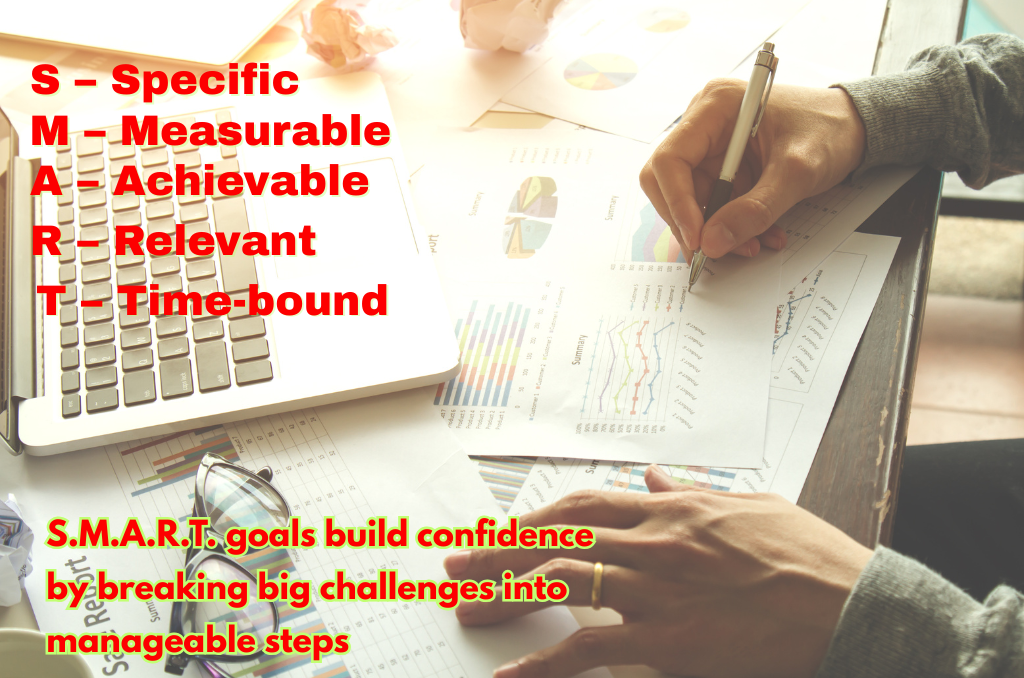
For teenagers facing exams, S.M.A.R.T. goals build confidence by breaking big challenges into manageable steps. Each small achievement boosts self-belief and keeps motivation high, helping you stay focused, organized, and thus positive, building confidence throughout your exam preparation journey.
Practical Tips to Achieve Your Goals
- Create a Study Plan—Divide your syllabus into manageable sections and allocate due dates to each subject.
- Use Effective Study Techniques—Try using mind maps, flashcards, active learning, and previous exam papers.
- Stay Consistent—Last-minute stressing is less advantageous than daily practice.
- Take breaks and rest well—your brain necessitates rest in order to organize and maintain information.
- Stay Healthy—Maintain a sharp intellect by eating a healthy diet, doing physical activity, and obtaining enough sleep.
The Power of a Positive Mindset
Your thinking significantly influences your exam success. You may embrace challenges and continue your progress in building confidence by adopting a growth mindset, which holds that knowledge and abilities can be developed for building confidence. Here are a few strategies for establishing a positive prospect and building confidence:
- Visualizing results prior to tests
- Using meditation or breathing exercises to preserve calmness
- Rewarding yourself for small achievements
- Avoiding comparison with others

unnecessary anxiety for quite a number of teenagers
Conclusion: Believe in Yourself and Aim High
Setting goals for building confidence is about achieving all that you can achieve, not about placing constraints on yourself. Teenagers’ exam preparation becomes more focused and achievable and less stressful if they set specific and meaningful goals. Trusting yourself can help you overcome self-doubt and mental barriers that often hinder your progress in building confidence. Exams are crucial, but they don’t decide your worth or future. Create lofty goals, keep consistency, and maintain confidence in the process. Success becomes an inevitable outcome of your hard work and determination if you have an appropriate mindset, meticulous preparation, and building confidence.
Now is the time to start the process with a confident you!
Setting goals to boost your confidence is more than simply a tactic; it’s an empowering habit that has the greatest potential to influence your future and build confidence. Every tiny objective you establish and achieve serves as a starting point to become a more powerful, self-assured version of yourself. So why hold off?
Start your journey right now. No matter how little the goal seems to be, put it in writing, break it down into manageable steps, then take action. Remember that building confidence takes time; it requires diligence, consistent effort, and self-confidence.
Don’t keep these ideas to yourself if you found them useful. Tell your friends, classmates, or anyone else who needs a motivational boost about this post. Together, let’s create a community of self-assured, ambitious individuals!
To keep your growth journey going, don’t forget to go ahead and check out more student-focused and motivational articles on our website. Take the first step toward your success story right away!
6 thoughts on “Building confidence through goal setting: Tips for Teenagers”